What Is an EIN?
-
A nine-digit number assigned to businesses by the IRS (format: XX-XXXXXXX).
-
Serves as the business equivalent of a Social Security Number (SSN) for tax and legal purposes.
-
Required for most businesses, including corporations, partnerships, LLCs, and some sole proprietors.
Filing Federal Taxes
-
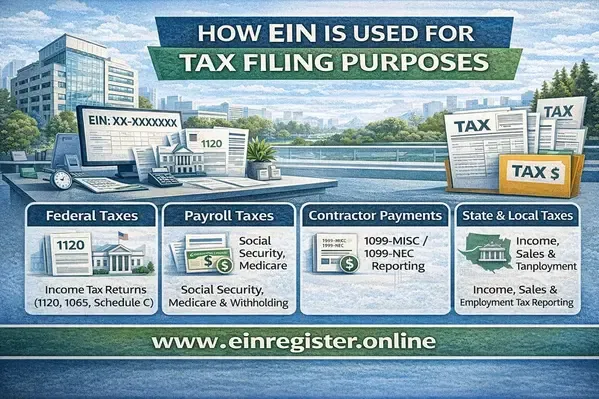
Income Tax Returns – Businesses use their EIN to file federal income taxes with the IRS.
-
Employment Taxes – If your business has employees, you must report payroll taxes, Social Security, and Medicare taxes using your EIN.
-
Excise Taxes – Businesses in certain industries (e.g., fuel, transportation, alcohol, or tobacco) use EINs to report excise taxes.
Example: A corporation files Form 1120 using its EIN to report income, deductions, and tax liabilities.
Filing State and Local Taxes
-
Many states require businesses to use the same EIN for state income taxes, sales taxes, and payroll withholding.
-
Some states issue a separate state tax ID, but the EIN is often referenced in all filings.
-
Local jurisdictions may also require the EIN for business licenses and tax reporting.
Reporting Payments to Contractors and Vendors
-
Businesses use their EIN when issuing Form 1099-MISC or 1099-NEC to independent contractors.
-
The EIN identifies the business as the payer when reporting to the IRS.
Compliance Tips
-
Keep your EIN confidential to prevent identity theft or fraud.
-
Use the EIN consistently on all tax forms and filings.
-
Update the IRS if your business changes its structure or ownership.
-
Apply for an EIN before hiring employees or opening business bank accounts.
Summary Table
| Purpose | How EIN Is Used |
|---|---|
| Federal Income Tax | Filing Form 1120, 1065, 1040 Schedule C, etc. |
| Payroll Taxes | Reporting Social Security, Medicare, and federal withholding |
| Contractor Payments | Filing Form 1099-MISC/1099-NEC |
| Excise Taxes | Reporting industry-specific taxes |
| State/Local Taxes | Filing state income, sales, and employment taxes |
The EIN ensures proper identification of your business for all federal, state, and local tax obligations, streamlining reporting, compliance, and payments.