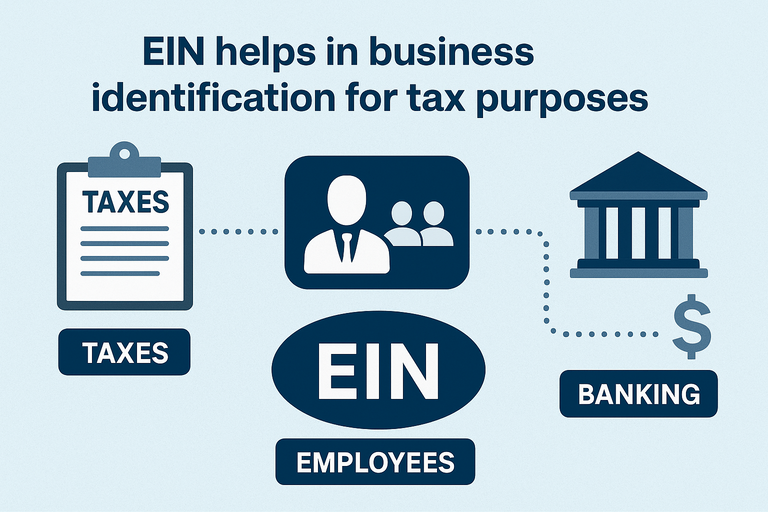
1. Unique Business Identifier
-
The EIN is a unique nine-digit number assigned by the IRS to each business entity.
-
It functions similarly to a Social Security Number (SSN) but for businesses.
-
This uniqueness ensures that the IRS can distinguish one business from another, even if multiple businesses have similar names.
2. Tax Reporting
-
Businesses use their EIN to file federal tax returns, including income tax, payroll tax, and excise tax.
-
Without an EIN, many businesses would not be able to report taxes correctly or separate their business income from personal income.
-
It simplifies tax processing by giving the IRS a consistent reference for all filings.
3. Employment Taxes
-
When hiring employees, a business must report wages and withhold taxes.
-
The EIN allows the IRS to track employment taxes and ensure compliance with federal laws.
-
Forms like W-2, W-3, and 941 all require the business’s EIN.
4. Banking and Financial Transactions
-
Most banks require an EIN to open business accounts or apply for loans.
-
The EIN links all financial and tax-related transactions to the specific business entity.
5. Legal and Compliance Purposes
-
The EIN is often required when registering for state taxes, obtaining licenses, or interacting with other government agencies.
-
It helps maintain a clear legal record of a business for both federal and state authorities.
In short: The EIN is the IRS’s way of uniquely identifying a business, ensuring proper tax reporting, employment tax compliance, and legal recognition. Without it, a business cannot operate efficiently or legally in the U.S.