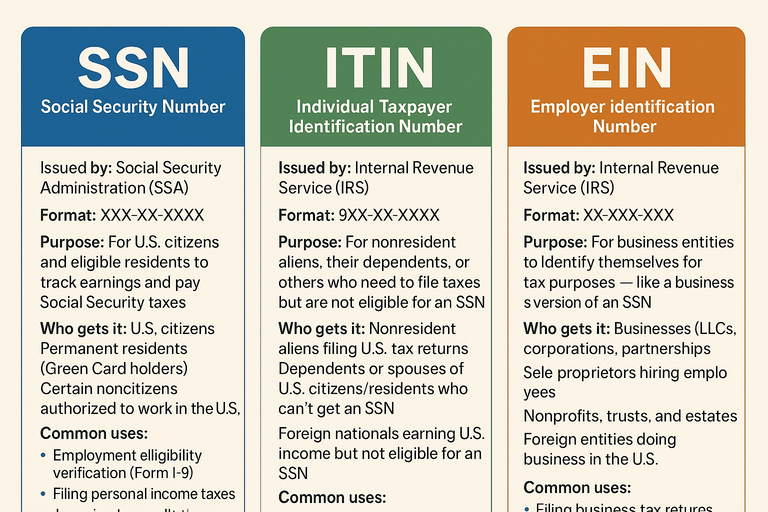
Social Security Number (SSN)
What it is:
-
The SSN is a nine-digit number issued by the Social Security Administration (SSA) to U.S. citizens, permanent residents, and certain work-authorized non-citizens.
-
Format is typically
XXX-XX-XXXX.
Primary uses:
-
Work authorization and reporting wages.
-
Filing individual income tax returns (personal tax ID).
-
Access to Social Security benefits (for eligible individuals).
-
Opening many bank accounts, applying for loans, registering for certain government services.
When you need it:
-
If you live in the U.S. and are eligible to work (citizen or authorized).
-
If you are going to be paid wages by an employer.
-
Generally, you should not get an ITIN if you’re eligible for an SSN.
Key limitation:
-
If you were eligible for an SSN, you can’t keep an ITIN; you’d switch to your SSN and notify the IRS.
Individual Taxpayer Identification Number (ITIN)
What it is:
-
The ITIN is a nine-digit number issued by the Internal Revenue Service (IRS) to individuals who cannot obtain an SSN but still have U.S. tax-filing obligations.
-
Format: begins with a “9”, e.g.,
9XX-XX-XXXX.
Primary uses:
-
For individuals (resident or nonresident aliens) who need to file U.S. tax returns or claim treaty benefits but are not eligible for an SSN.
-
It does not authorize work in the U.S., nor does it provide Social Security benefits.
When you need it:
-
If you’re a non-resident alien or resident alien for tax purposes, you don’t have/work authorization for an SSN, but you must file a U.S. tax return or get a U.S. tax ID.
Key limitation:
-
Cannot be used instead of an SSN if you actually are eligible for an SSN.
-
Does not grant eligibility for many tax credits (for example, the Earned Income Tax Credit).
Employer Identification Number (EIN)
What it is:
-
The EIN is a nine-digit number issued by the IRS as a federal tax identification number for businesses, trusts, estates, and other entities.
-
Format: often
XX-XXXXXXX.
Primary uses:
-
Identifying a business entity for tax filings, payroll, opening business bank accounts.
-
Required if your business has employees, operates as a corporation or partnership, files certain tax returns, or withholds taxes for non-resident aliens.
When you need it:
-
If you have a business entity distinct from a sole proprietor using their SSN, or you hire employees.
-
Many businesses obtain one even if not strictly required, to separate personal and business finances.
Key limitation:
-
Cannot be used in place of an SSN or ITIN for an individual’s personal tax filing. Entities and individuals are separate.
Quick Comparison Table
| ID Type | Issuing Agency | Format | Issued To | Primary Use |
|---|---|---|---|---|
| SSN | SSA | XXX-XX-XXXX |
U.S. citizens + authorized workers | Personal identification for work & tax |
| ITIN | IRS | 9XX-XX-XXXX |
Individuals not eligible for SSN but must file taxes | Tax filing only (no work authorization) |
| EIN | IRS | XX-XXXXXXX |
Businesses, trusts, estates, etc. | Business tax ID, payroll, business banking |
Why It Matters
-
Using the wrong ID on tax forms or for payroll can create compliance issues or delays.
-
Keeping personal and business finances separate (e.g., using EIN for business rather than SSN) helps with privacy, accounting, and liability.
-
Non-residents, foreign nationals, and business owners must be especially careful to choose the correct ID, apply properly, and maintain compliance.