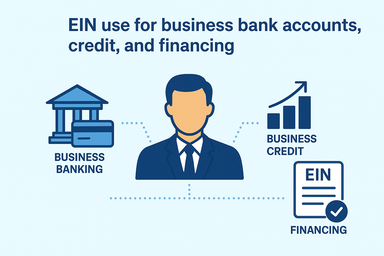
EIN Use for Business Bank Accounts, Credit, and Financing
1. EIN for Business Bank Accounts
-
Why banks require it:
-
Banks need an EIN to verify the legal identity of your business with the IRS.
-
It allows them to report interest, handle tax documentation, and comply with “Know Your Customer” (KYC) and anti-money-laundering laws.
-
-
Who needs it:
-
LLCs, corporations, partnerships, and nonprofits must have an EIN before opening a business bank account.
-
Sole proprietors may use an SSN but often choose an EIN to separate personal and business finances.
-
-
What you’ll typically need to open the account:
-
Your EIN confirmation letter from the IRS (CP 575 or 147C letter).
-
Formation documents (Articles of Organization/Incorporation).
-
Ownership agreements and ID for authorized signers.
-
-
Benefits:
-
Keeps personal and business funds legally separate.
-
Simplifies accounting, tax filing, and potential audits.
-
Builds credibility with vendors and financial institutions.
-
2. EIN and Business Credit
-
EIN = the foundation of your business credit profile.
-
Credit bureaus like Dun & Bradstreet, Experian Business, and Equifax Business track credit activity using your EIN.
-
It’s essentially your business’s SSN for credit purposes.
-
-
Steps to build credit using your EIN:
-
Open a business bank account in your company’s legal name using your EIN.
-
Apply for trade credit with suppliers that report to credit bureaus.
-
Pay invoices and loans on time to build a positive record.
-
Apply for a D-U-N-S number (free from Dun & Bradstreet) to link your EIN with your business credit file.
-
-
Why it matters:
-
A strong business credit score helps you qualify for higher credit limits, lower interest rates, and vendor financing without personal guarantees.
-
3. EIN for Business Loans and Financing
-
When lenders require your EIN:
-
For any corporate or business loan application, including SBA loans, lines of credit, equipment financing, and merchant cash advances.
-
It identifies your business entity on loan documents and allows lenders to check your credit history.
-
-
Types of financing linked to EIN:
-
SBA Loans: Most SBA lenders use your EIN to process and verify your business’s financial identity.
-
Equipment or vehicle loans: Financing companies use your EIN for asset-backed loans tied to the business.
-
Vendor and trade credit: Many vendors offer net-30 accounts (30 days to pay) that report activity under your EIN.
-
-
Tip: Keep your EIN consistent across all applications and documents — discrepancies can delay approval.
4. EIN Protects Your Personal Finances
-
Separating your EIN (business) from your SSN (personal) helps:
-
Limit personal liability and protect your credit.
-
Prevent business defaults from impacting your personal score.
-
Reduce identity theft exposure since your SSN isn’t shared on business documents.
-
5. EIN and Banking Compliance
Banks and lenders use your EIN to:
-
File IRS Form 1099-INT (interest income).
-
Verify federal tax reporting (Form 1120, 1065, etc.).
-
Confirm your business’s status and legitimacy.
Tip: Keep your EIN documentation in a secure, easily accessible place — lenders or the IRS may request it for verification.
6. Common Mistakes to Avoid
-
Using your SSN for business loans when you already have an EIN — it blurs personal and business credit.
-
Forgetting to update your EIN information with the IRS after major changes (ownership, structure, or name).
-
Applying for financing before your business credit file is established.
Key Takeaways
| Purpose | EIN’s Role |
|---|---|
| Bank Account | Required to open and maintain business accounts for LLCs, corporations, and partnerships. |
| Business Credit | Used by credit bureaus to build your business credit profile. |
| Financing | Identifies your business on loan applications and credit reports. |
| Compliance | Ensures federal tax tracking and legal separation from personal finances. |