Who Needs an EIN?
Here are common situations where an EIN is required, even for non-U.S. persons:
-
If you (as an individual) are engaged in a trade or business in the U.S., or have employees in the U.S. you’ll need a TIN (Tax Identification Number). According to IRS Pub 519, an individual may need an EIN if they are engaged in a U.S. trade or business.
-
If you form a U.S. entity (for example an LLC or Corporation) and that entity has U.S. operations (employees, income from U.S. sources, etc.), the entity is required to have an EIN. For entities: “Any person other than an individual … who is an employer or who is engaged in a trade or business as a sole proprietor should use an employer identification number.”
-
If you have U.S. source income (subject to withholding or not fully satisfied by withholding) even if you do not operate a business in the U.S., you may still need an EIN (for withholding, treaty benefits, etc.)
-
If your foreign entity becomes “effectively connected” with a U.S. trade or business, you’ll need an EIN.
How Non-U.S. Citizens / Foreign Entities Apply for an EIN
Since you don’t have a U.S. Social Security Number (SSN) or possibly even an Individual Taxpayer Identification Number (ITIN), there are special steps:
-
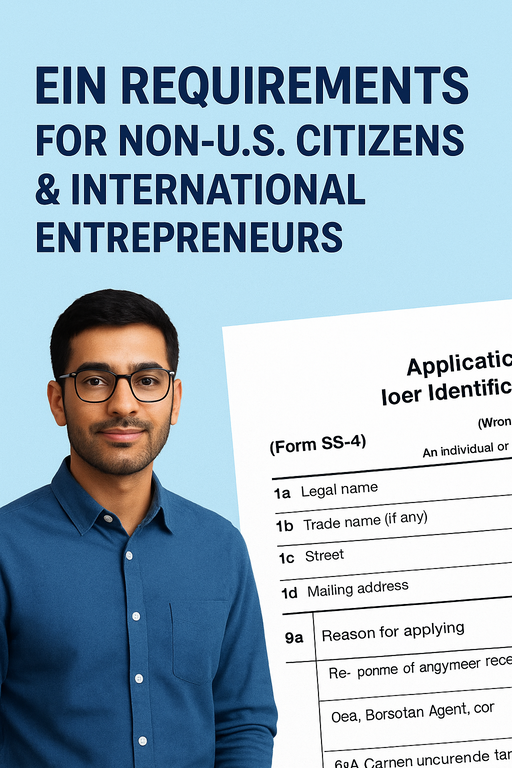
Prepare Form SS-4 (Application for Employer Identification Number)
-
On line 7a: Name of the “responsible party” (the person who controls/applicants the entity)
-
On line 7b (SSN/ITIN): If the responsible party does not have an SSN/ITIN, you can write “Foreign” or “N/A” per instructions.
-
On line 10 (“Reason for applying”): choose appropriate reason (e.g., “Started a new business”)
-
Indicate correct entity type (corporation, LLC, sole proprietor, etc.) and U.S. address (if you have one) or note that you have no U.S. residence/principal office.
-
-
Submission method for foreign/non-resident applicants
-
Online application is not available if you do not have an SSN or ITIN.
-
Options:
-
Fax: to the IRS international fax number (e.g., 304-707-9471) – many applicants receive EIN within ~4 business days.
-
Mail: to IRS Mike (Attn: EIN International Operation, Cincinnati, OH 45999) – takes several weeks (4-6+ weeks) especially for foreign applicants.
-
Phone: Only for international applicants (no U.S. legal residence/office) you can call the IRS international EIN line at 502-547-2551 (toll-free) during business hours. The IRS will ask the SS-4 questions and issue the EIN at the end of the call.
-
-
-
After you receive the EIN
-
The IRS will send you a confirmation (CP 575) or other official letter. Keep it safe.
-
Use the EIN whenever you file U.S. tax returns, open U.S. bank accounts, apply for business licenses, pay employees, etc.
-
Update entity information with IRS if needed (address change, responsible party change, etc.).
-
Key Considerations & Pitfalls
-
Physical U.S. presence vs only mailing address: Having a U.S. mailing address alone is not sufficient for the IRS online application if you don’t have SSN/ITIN. Many guides say foreigners must fax/mail.
-
Correct “responsible party” designation: The responsible party must be a person (not an entity) who has control over the entity’s funds and assets. Mistakes here cause processing delays.
-
Using “Foreign” or “N/A” when no SSN/ITIN: On Form SS-4 line 7b you should note “Foreign” or “N/A” if the responsible party lacks SSN or ITIN.
-
Timelines: Foreign applicants should expect longer processing times than U.S. persons. Fax is faster (~5-15 business days) vs mail (~4-6 or more weeks) depending on workload.
-
Avoid online portal if you don’t have SSN/ITIN: Attempting to apply online without proper ID will lead to rejection or delays.
-
Tax obligations follow EIN issuance: Getting an EIN doesn’t relieve you of U.S. tax obligations. Once you have a U.S. business or U.S. source income, you may have filing requirements.
-
Using correct entity classification: Especially for foreign-owned U.S. LLCs, be aware of how the IRS treats the entity (disregarded entity vs corporation vs partnership) for tax filing. This can affect whether a W-9 or W-8BEN/E must be filed. (Illustrated in real-world forums.)
Example Use Cases
-
A German entrepreneur forms a U.S. LLC in Delaware, wishes to open a U.S. bank account and accept U.S. marketplace sales: she does not have an SSN/ITIN — she completes Form SS-4 (line 7b “Foreign”), faxes it to IRS, obtains the EIN, uses it for banking.
-
A Canadian software developer who lives in Canada but forms a U.S. Corporation (C-Corp) for U.S. operations: needs an EIN for the corporation, even though he is non-U.S. citizen.
-
A foreign corporation with U.S. branch: If the branch is effectively a U.S. trade or business, the branch must have an EIN and file U.S. returns. The foreign corporation cannot rely solely on a foreign tax ID.