What Is an EIN?
An EIN (Employer Identification Number) is a unique 9-digit number issued by the IRS to identify a business for tax, banking, and compliance purposes. It works like a Social Security Number for a business.
Do Foreign-Owned Businesses Need an EIN?
Yes. A foreign-owned business must obtain an EIN if it:
-
Is registered in the United States (LLC, Corporation, Partnership)
-
Opens a US business bank account
-
Files US federal tax returns
-
Has employees in the US
-
Is a single-member LLC owned by a non-US resident
-
Is required to file IRS Form 5472
Even if the business has no US employees, an EIN is still required in most cases.
Who Can Apply?
Foreign owners do NOT need:
-
A US Social Security Number (SSN)
-
An Individual Taxpayer Identification Number (ITIN)
-
US citizenship or residency
Non-US individuals and companies are fully eligible to apply.
How to Apply for an EIN as a Foreign Owner
Option 1: Apply Online
Option 2: Apply by Phone
-
(502) 547-2551
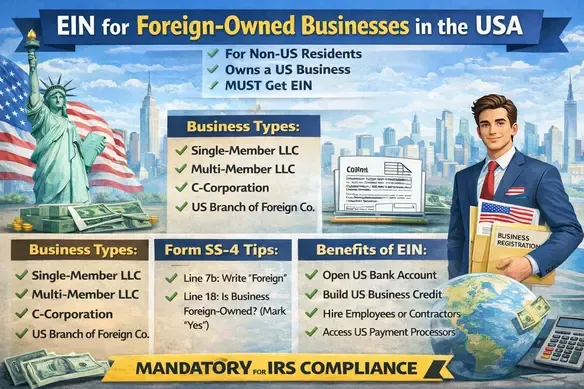
Common US Business Types for Foreign Owners
-
Single-Member LLC (most popular)
-
Multi-Member LLC
-
C-Corporation
-
US Branch of a Foreign Company
Each structure has different tax and reporting obligations.
Tax & Reporting Obligations
Foreign-owned US businesses may need to file:
-
Form 5472 (mandatory for foreign-owned single-member LLCs)
-
Federal income tax returns
-
State tax filings (depending on location)
Failure to file required forms can result in penalties up to $25,000.
Can You Open a US Bank Account with an EIN?
Yes. Most US banks require:
-
EIN confirmation letter (CP 575)
-
US business registration documents
-
Passport of the owner
-
Sometimes a US address
Some fintech banks may allow remote account opening.
Benefits of Having an EIN
-
Legal compliance with IRS rules
-
Ability to open US bank accounts
-
Hire employees or contractors
-
Build US business credibility
-
Access US payment processors (Stripe, Amazon, PayPal)
Final Thoughts
Getting an EIN is a mandatory and foundational step for foreign-owned businesses operating in the United States. While the process is straightforward, accuracy is critical to avoid delays or penalties.