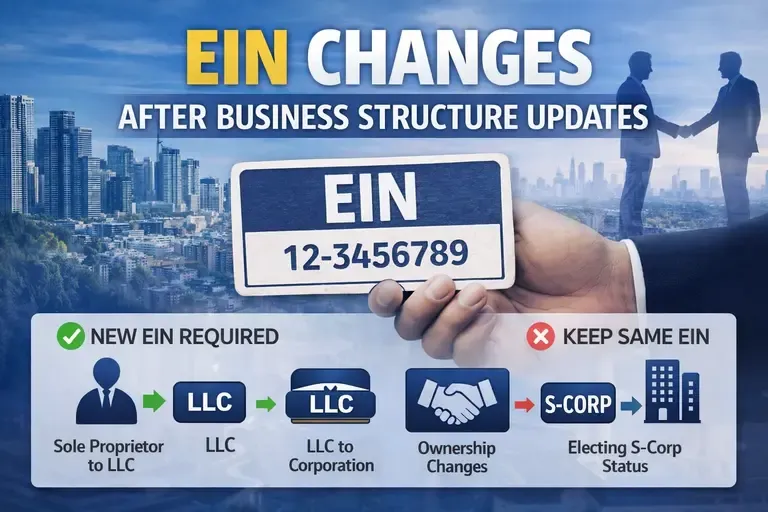
What Is a Business Structure Change?
A business structure change occurs when your company’s legal or tax classification changes, such as:
-
Sole proprietorship → LLC
-
LLC → Corporation
-
Partnership → Corporation
-
Change in ownership that affects tax status
Not every change requires a new EIN—but some do.
When You Need a New EIN
You must apply for a new EIN in the following situations:
1. Sole Proprietorship → LLC or Corporation
-
A sole proprietor who forms an LLC taxed as a corporation or a C-Corp/S-Corp must obtain a new EIN.
-
Exception: A single-member LLC taxed as a sole proprietorship may continue using the existing EIN (if one already existed).
2. Partnership → Corporation or LLC Taxed as Corporation
-
If a partnership incorporates or elects corporate taxation, a new EIN is required.
3. LLC Changes Tax Classification
You need a new EIN if:
-
An LLC taxed as a sole proprietorship elects corporate taxation
-
An LLC taxed as a partnership converts to a corporation
4. Corporation Changes Ownership Structure
-
If a corporation forms a new corporation through merger or consolidation, a new EIN is required.
-
Creating a subsidiary also requires a separate EIN.
When You Do NOT Need a New EIN
In these cases, you typically keep the same EIN but must notify the IRS:
1. LLC Ownership Changes
-
Adding or removing members (without changing tax classification)
-
Single-member LLC becoming multi-member (still taxed as partnership)
2. Business Name Change
-
Changing the company name does not require a new EIN
-
Must notify the IRS in writing
3. Change of Business Address
-
EIN stays the same; update the IRS records
4. Electing S-Corp Status
-
A corporation or LLC electing S-Corp status usually keeps the same EIN
How to Notify the IRS of EIN-Related Changes
Depending on the change, you may need to:
-
File IRS Form 8822-B (address or responsible party change)
-
Send a signed letter to the IRS explaining the update
-
File a new EIN application if required
Banks, payroll providers, and state agencies should also be notified to keep records consistent.
Common Mistakes to Avoid
-
Applying for a new EIN when it’s not required
-
Failing to update the IRS after ownership changes
-
Using the wrong EIN after restructuring
-
Not aligning EIN changes with state registrations and licenses
These mistakes can lead to delayed tax filings or rejected payroll submissions.
Practical Tip
Before restructuring your business:
-
Confirm how the IRS classifies the new entity
-
Check whether the change affects federal tax identity
-
Align EIN updates with bank accounts, permits, and licenses
Summary
| Business Change | New EIN Required? |
|---|---|
| Sole proprietor → Corporation | Yes |
| Sole proprietor → Single-Member LLC (disregarded entity) | No |
| Partnership → Corporation | Yes |
| LLC tax status change | Sometimes |
| Name or address change | No |
| S-Corp election | No |