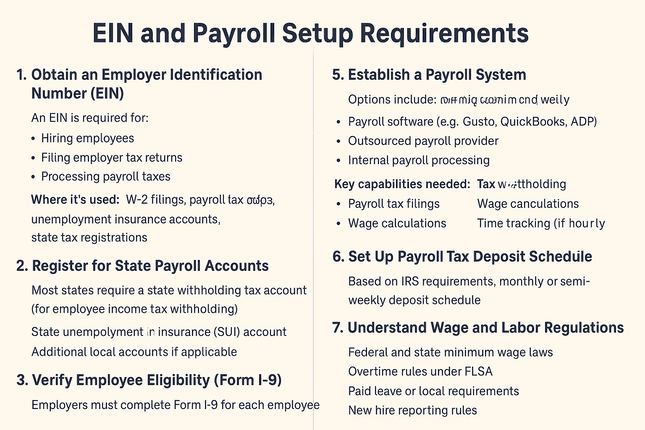
1. Why an EIN Is Required for Payroll
An Employer Identification Number is issued by the IRS and is required for:
-
Hiring employees
-
Reporting payroll taxes
-
Filing quarterly and annual tax returns
-
Issuing W-2s to employees
-
Opening payroll-related bank accounts
-
Withholding and depositing federal income tax
Without an EIN, payroll systems, banks, and tax agencies cannot process employee wage information.
2. Steps to Get an EIN
To begin payroll setup, a business must obtain an EIN from the IRS.
How to apply:
-
Online through the IRS EIN Assistant (fastest option)
-
By mail using Form SS-4
-
By fax
-
By phone (for foreign applicants only)
Once issued, the EIN is active immediately for payroll and tax purposes.
3. Federal Payroll Setup Requirements
Before running payroll, employers must complete several federal requirements:
A. Register for an EIN (IRS Form SS-4)
This identifies the employer in all payroll records.
B. Complete Form I-9 for EACH Employee
Used to verify identity and work authorization.
C. Collect Form W-4 From Employees
This determines how much federal income tax to withhold from their paychecks.
D. Submit New Hire Reports
Each newly hired worker must be reported to the state's New Hire Registry within 20 days (or sooner in some states).
4. State Payroll Setup Requirements
Depending on the state, employers may need to register for:
A. State Employer Payroll Tax ID
Used for reporting:
-
State income tax withholding
-
Unemployment insurance tax (SUTA)
B. State Disability Insurance (SDI) or Paid Leave Programs
Required in states such as:
-
CA
-
NY
-
NJ
-
WA
-
MA
-
CT
-
RI
Each state has its own deadlines and registration portals.
5. Payroll Tax Deposit Requirements
Employers must deposit federal payroll taxes, which include:
-
Federal income tax withholding
-
Social Security taxes
-
Medicare taxes
Deposits are made electronically using the EFTPS (Electronic Federal Tax Payment System).
Deposit schedules may be:
-
Monthly
-
Semiweekly
-
Next-day deposit (for large liabilities)
Schedules depend on the employer's lookback period and total payroll tax liability.
6. Required Federal Payroll Tax Forms
Employers must file several recurring forms:
Quarterly:
-
Form 941 – Employer’s Quarterly Federal Tax Return
Annually:
-
Form W-2 – Wage and Tax Statement for each employee
-
Form W-3 – Transmittal summary of W-2s
-
Form 940 – Annual Federal Unemployment Tax (FUTA) Return
Missing any of these filings can result in penalties.
7. Payroll Records Employers Must Keep
Employers must maintain payroll records for at least 4 years, including:
-
EIN and business tax records
-
Employee personal data
-
Hours worked
-
Wage rates
-
Tax withholding information
-
Payroll tax filing receipts
-
Benefit deductions
Records may be stored digitally or physically but must be accessible for audits or employee requests.
8. Penalties for Incorrect EIN or Payroll Setup
Common mistakes and their consequences:
-
Using an incorrect EIN → Filing rejections, IRS penalties
-
Failing to register for state payroll accounts → State fines
-
Late payroll tax deposits → Interest + penalties
-
Incorrect W-2s → IRS corrections and penalties
-
Missing quarterly forms → IRS enforcement actions
Proper setup prevents costly compliance issues.
Summary
Setting up payroll in the U.S. requires:
-
Obtaining an EIN
-
Completing employee forms (I-9, W-4)
-
Registering for state payroll accounts
-
Using EFTPS for federal tax deposits
-
Filing required quarterly and annual reporting
-
Maintaining compliant payroll records
An EIN is the foundation of payroll compliance—every other payroll requirement depends on it.