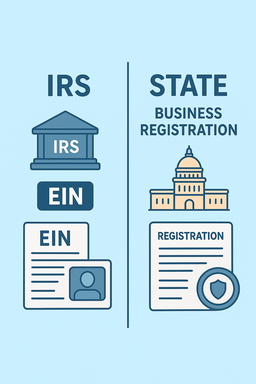
EIN and Business Registration: Differences Between IRS and State Filings
1. Different Purposes
| Process | Agency | Purpose |
|---|---|---|
| EIN (Employer Identification Number) | Internal Revenue Service (IRS – federal) | Identifies your business for federal tax purposes (like a Social Security Number for your business). |
| Business Registration | State government (usually Secretary of State) | Legally forms or authorizes your business entity (LLC, corporation, partnership, etc.) to operate in that state. |
2. What Each One Does
EIN (IRS)
-
Used for:
-
Filing federal taxes (income, payroll, excise).
-
Opening a business bank account.
-
Hiring employees.
-
Applying for certain licenses.
-
-
You apply using Form SS-4 through the IRS.
-
It’s free and issued instantly online (for U.S. residents) or by fax/mail for foreign applicants.
Business Registration (State)
-
Creates your legal business entity under state law.
-
You file Articles of Organization (LLC) or Articles of Incorporation (Corporation).
-
Involves state fees, name checks, and annual reports.
-
Must be done before or in conjunction with obtaining your EIN.
3. Legal Authority
-
State registration gives your company the legal right to exist and do business.
-
EIN gives your company a tax identity for federal reporting.
Think of it this way:
The state “creates” your business.
The IRS “recognizes” it for tax purposes.
4. Timing
-
Generally, you should register your business with the state first, then apply for an EIN.
-
Exception: if you’re forming a sole proprietorship, you can get an EIN first since no state formation is required.
5. Fees and Costs
| Process | Typical Cost | Paid To |
|---|---|---|
| EIN Application | Free | IRS |
| State Registration | $50–$500+ (varies by state) | Secretary of State or equivalent agency |
6. Jurisdiction
-
The EIN is federal and applies nationwide.
-
State registration applies only in the state(s) where you operate.
-
If you expand into another state, you must register as a foreign entity in that state — but you don’t need a new EIN.
-
7. Ongoing Requirements
| EIN (IRS) | Business Registration (State) |
|---|---|
| File federal tax returns (Form 1120, 1065, etc.) | File annual/biennial reports |
| Maintain IRS correspondence | Maintain good standing with the state |
| Update IRS if ownership or structure changes | Update registered agent, address, or ownership with the state |
8. Common Misconceptions
-
Getting an EIN does not mean your business is legally registered.
-
Registering your LLC or corporation does not automatically get you an EIN.
-
Both are required for a properly established, compliant business.
9. Who Handles Each
| Task | Agency | Website |
|---|---|---|
| EIN Application | Internal Revenue Service (IRS) | irs.gov/businesses |
| Business Registration | Your State’s Secretary of State | Varies by state (e.g., sos.ca.gov, dos.ny.gov) |
10. Quick Example
Scenario:
You start “Global Tech LLC” in California.
-
You register with the California Secretary of State — now you legally exist.
-
You apply for an EIN with the IRS — now you can pay taxes and open a bank account.
Two separate steps, but both essential.