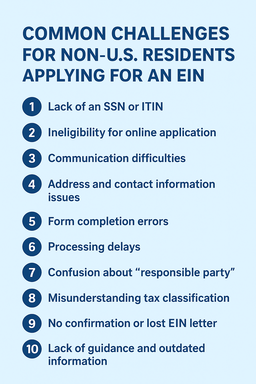
1. No Social Security Number (SSN) or Individual Taxpayer Identification Number (ITIN)
-
Problem: The IRS EIN application form (Form SS-4) asks for a “responsible party” with an SSN, ITIN, or existing EIN.
-
Why it matters: Non-U.S. residents often don’t have any of these.
-
Solution:
-
You can leave that field blank and note “Foreign” on Form SS-4.
-
You must apply by phone or fax/mail (not the online application), since the online system requires an SSN or ITIN.
-
2. Limited Access to the Online Application System
-
Problem: The IRS online EIN application is available only to applicants with a U.S. taxpayer ID and a U.S. address.
-
Solution:
-
Foreign entities must apply by fax or mail to the IRS (or sometimes by phone).
-
Processing time can be 2–4 weeks by fax, and 4–6 weeks by mail.
-
3. Difficulty Contacting the IRS
-
Problem:
-
International phone calls to the IRS Business & Specialty Tax Line can be costly and time-zone-challenging.
-
Wait times can be long, and some agents may not be familiar with foreign entity structures.
-
-
Solution:
-
Use the dedicated international number: +1-267-941-1099 (not toll-free).
-
Call during U.S. business hours (Mon–Fri, 6 a.m.–11 p.m. Eastern Time).
-
4. Unclear U.S. Business Structure
-
Problem: Many non-U.S. applicants aren’t sure how to classify their U.S. business for IRS purposes — LLC, corporation, or foreign entity.
-
Solution:
-
Consult a U.S. tax advisor before applying.
-
The EIN form (SS-4) requires the entity type and reason for applying — these choices affect future tax filings.
-
5. Mailing Address & Delivery Issues
-
Problem:
-
The IRS requires a mailing address for correspondence. Foreign addresses are accepted, but IRS mail delivery can be slow or inconsistent abroad.
-
-
Solution:
-
Consider using a U.S. mailing address (e.g., registered agent or virtual office) to receive IRS notices reliably.
-
6. Confusion About Documentation
-
Problem: The IRS doesn’t require incorporation documents for EIN issuance, but many applicants assume they need to attach them.
-
Solution:
-
Usually, only the Form SS-4 is required.
-
However, be prepared to provide supporting documents (like your certificate of formation) if the IRS requests verification.
-
7. Delays or Lost EIN Confirmation Letters
-
Problem: It’s common for foreign applicants not to receive their CP 575 confirmation letter by mail.
-
Solution:
-
You can call the IRS to request a replacement letter (Form 147C).
-
Always keep fax confirmation pages or any correspondence showing your EIN approval.
-
8. Misunderstanding Tax Obligations
-
Problem: Some foreign entities believe that obtaining an EIN automatically creates a U.S. tax filing requirement — which isn’t always true.
-
Solution:
-
An EIN by itself doesn’t trigger taxation.
-
Filing obligations depend on your U.S. activities, ownership, and structure.
-
Always confirm with a U.S. tax professional.
-
9. Processing Time and Bureaucracy
-
Problem: Manual review for foreign applications makes processing slower.
-
Solution:
-
Fax is faster than mail.
-
Include a return fax number on your SS-4 form to get your EIN faster (usually within 1–2 weeks).
-
10. Confusion Between EIN and ITIN
-
Problem: Non-U.S. individuals sometimes think they need an EIN when they actually need an ITIN (for personal tax filing).
-
Solution:
-
EIN → for businesses, trusts, or entities.
-
ITIN → for individuals filing U.S. taxes but not eligible for an SSN.
-